Fasting isn’t starvation. It’s a switch nobody showed you.
You count calories, eat five times a day, watch the clock, and the scales won’t budge while your energy lurches about. Meanwhile someone else simply skipped breakfast, squeezed their food into a single window and dropped a stone, lost the fog in their head and says they haven’t felt this good in years. Fasting isn’t a fad and it isn’t wrecking yourself. It’s a controlled break in which the body switches over to burning its own store. The whole trick is knowing when it’s a powerful tool, and when it’s better left on the shelf.
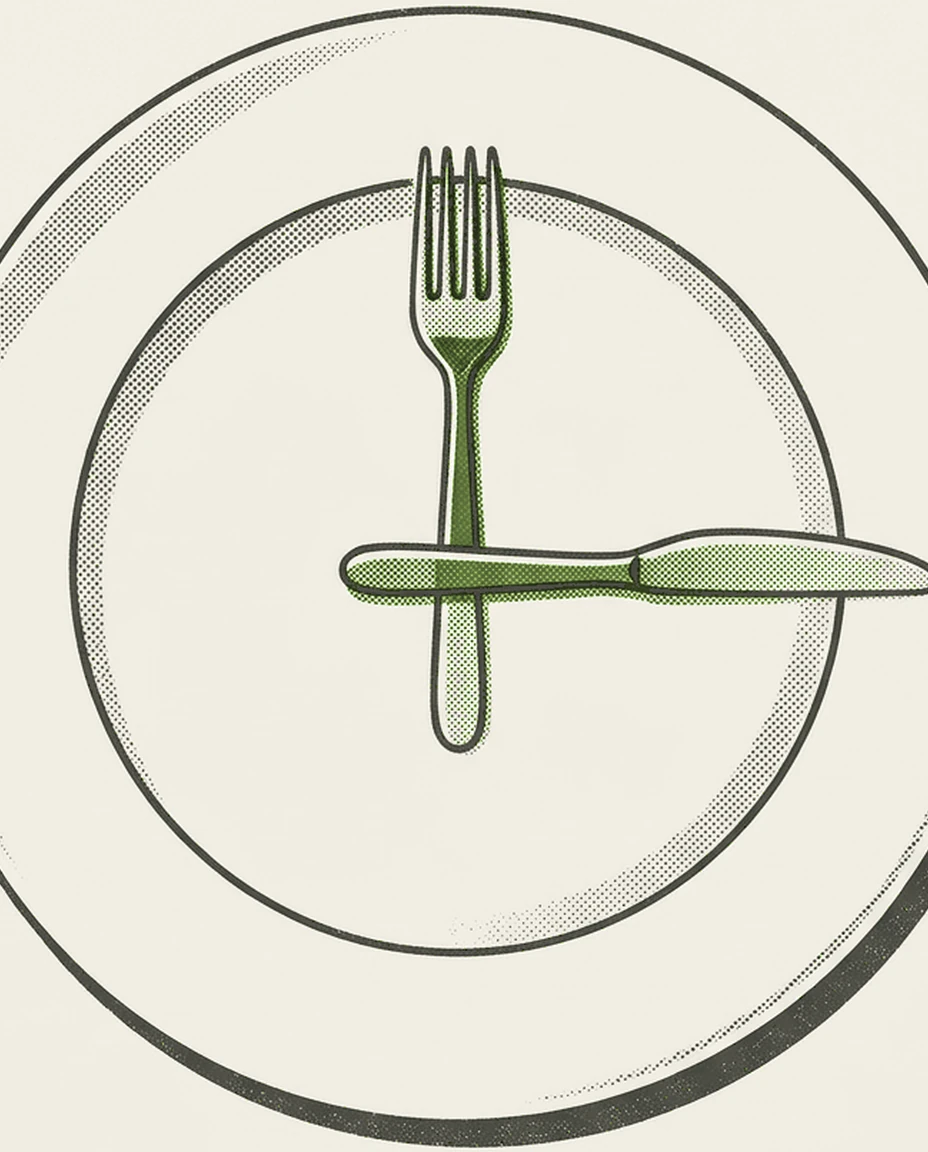
Every few hours after eating, irritability and a ravenous hunger come over you, and you feel chained to the fridge and the plate from morning till night.
You have fog in your head, energy dips and a belly that grows no matter how many times a week you exercise or how many diets you’ve already been through.
It isn’t a lack of willpower. It’s one hormone held high all day, the one that won’t let you reach your own fat.
“Breakfast is the most important meal of the day, and you must eat every three hours to fire up your metabolism.”
It sounds like revealed truth, but it grew out of cereal adverts, not physiology. Every meal lifts insulin, and insulin held high bolts the door to fat shut. Graze on something every three hours and you keep it up from morning till night, so that door never opens for a moment. There’s no firing up the metabolism here. There’s only constantly high insulin and a body storing without a break.
There’s another way. It starts with understanding the difference between fasting and starving, and with the order of steps nobody laid out for you, so the first days aren’t agony.
This isn’t a guide about miracles or a three-day detox that cures everything at once. I’m not promising you that fasting will cure anything. I’m promising something else: that you’ll understand how it works, who it genuinely helps, how to ease in so an adaptation slump doesn’t flatten you, and what’s worth checking in your blood. You get something harder than the internet’s “always fast, and for as long as possible”, namely an honestly drawn line: where fasting does the job, and where it starts to harm.
Inside, I break down what the mainstream doesn’t tell you:
- ●
It’s insulin that decides, not the calorie alone. As long as insulin is high, the body stores and won’t burn its own fat, however much you want it to. A break from eating lowers insulin, and only then does the door to the store open. This mechanism was popularised by the nephrologist Jason Fung.
- ●
You carry weeks of fuel inside you. The sugar stored in your liver and muscles lasts a day at most, but in fat you carry many times more energy. When that sugar runs out, the liver starts turning fat into ketone bodies, a clean, steady fuel the brain runs on beautifully. Hence that surprising clarity of mind instead of the weakness most people expect.
- ●
The first days are about salt, not hunger. When insulin falls, the kidneys excrete sodium, and water with it. Headache, fatigue and dizziness are most often plain electrolyte dehydration, not proof that fasting is doing harm. You fix it with a pinch of decent salt, not another diet.
- ●
Fasting is not the same as starving. Starving is running down reserves in someone who has no fuel left. Fasting is deliberately reaching for the store in someone who carries it. That’s why someone with extra weight and high insulin gains the most, and someone wasted away shouldn’t fast at all. It’s a tool, not a virtue.
What's inside
- ✓
An “is this you?” test — seven signals to tick off before you even begin.
- ✓
The ladder you climb — from twelve hours through the 16:8 window to narrower protocols, with one clear rule: you only climb when the previous rung is comfortable.
- ✓
A salt and water protocol — how to get through the first days without a headache, with ranges for magnesium and potassium and the gap to leave around levothyroxine.
- ✓
Scenarios for “what to do in which situation” — insulin resistance, a woman of reproductive age, a lean active man, shift work, the goal of weight loss versus longevity.
- ✓
A tests and markers table — what to ask for (fasting insulin and glucose, HOMA-IR, a lipid panel, electrolytes, thyroid) and how to read the results: the lab “normal” versus the optimum.
- ✓
Red flags — when you don’t fast alone and when to see a doctor at once, with a separate warning about refeeding syndrome.
- ✓
Your first 30 days and a shopping list — week by week, one thing at a time, plus what goes in the basket and what to bin from the cupboard.
This is for you if
- ✓you carry extra weight that resists every diet, with a sugar rollercoaster all day long
- ✓you suspect insulin resistance or prediabetes and want off the rollercoaster
- ✓you’ve had enough of five meals a day and watching the clock, and you want simplicity
- ✓you want to understand what autophagy really is before you believe the internet’s slogans
This isn't for you if
- ✕you’re after a three-day miracle off one video, with no grasp of the mechanism
- ✕you’re pregnant, breastfeeding, underweight or have a history of an eating disorder (this is no time for fasting)
- ✕you take insulin or diabetes medication and want to start without talking to your GP
Fasting is not an experiment to run on your own. The guide gives you clear red flags and a hard rule: if you take diabetes medication, especially insulin or an SGLT2 inhibitor (a “flozin”), or medication for blood pressure or your thyroid, you don’t start fasting without speaking to your GP, because the doses often have to be changed, and one of these combinations risks a life-threatening state that a glucose meter won’t pick up. If alarm symptoms appear, stop and call 999, or 111 for urgent advice. Naturopathy doesn’t compete with emergency medicine, and it never should.
Your body is built to survive breaks from food. It’s the constant eating that’s unnatural.
For most of our history nobody had a fridge full of snacks to hand, so the body learned to switch smoothly between eating and reaching for its own store. Today it’s the other way round: we eat from morning till night, insulin barely comes down, and the door to fat stays bolted round the clock. Fasting isn’t some trick for the initiated, it’s a return to the mode your body was meant to run in. And my enemy isn’t people and it isn’t one company, it’s the industry that made a fortune teaching us to fear every hour without something to nibble.
Fasting as a metabolic tool — have it right now
The PDF lands in your inbox the moment you pay. Read it on your phone, tablet or computer. Your copy is marked with your details (a named licence), for your own use.
Fasting works hardest where insulin resistance is doing the real work underneath. With the Metabolic bundle you add Insulin resistance to it for less and go after the true backdrop to the problem, while All-Access gives you every guide. See the bundles.
“The first thing I read about fasting that didn’t scaremonger or promise miracles. I understood the difference between fasting and starving, why the first days ache from salt rather than hunger, and when I shouldn’t fast at all. A concrete ladder and a list for the lab instead of ideology.”
A guide hands you the map. If you would rather go through your case with me, with a plan built around your results and your medication, come to a consultation.
See consultations